Monday, October 28, 2013
Gifts from the MaST Center
Guests who were around at Pacific Science Center’s Salt Water Tide Pool at noon Friday got the wonderful experience of meeting a bevy of new creatures.
Staff and volunteers from Highline Community College’s MaST (Marine Science and Technology) Center led by Kaddee Lawrence, with expert information from Rus Higley, hand delivered a group of exciting Puget Sound organisms. These new residents are for us to share with anyone who wants to learn more about the diversity of our regional shoreline.
In addition to bringing an infusion of bright color, the animals are an assorted mix of species. Best of all, they are a mix of non-aggressive animals that will not try to eat each other.
Many of the sea stars in our collection are Pisaster species, among the most predacious of all creatures in the intertidal zone. Yet, we love how durable they are, and how happily they eat readily available shellfish. With the new sea star species, we hope to have animals that are easily cared for and unlikely to eat other members of the exhibit. If these sea stars do well, the folks at MaST have offered to help us replace our current Pisaster population with these less hungry brethren. We will then plan a second round of new animals to include chitons, limpets and other animals that easily get eaten. Already our exhibit is more diverse by the addition of:
2 - Red sea urchins (Strongylocentrotus franciscanus)
1 - Purple sea urchin (Strongylocentrotus purpuratus)
1 - California sea cucumber (Parastichopus californicus)
1 - Kelp crab (Pugettia productus)
2 - Vermillion sea star (Mediaster aequalis)
2 - Blood stars (Henricia leviuscula)
1 - Mottled star (Evasterias troscheli)
1 - Sun star (Solaster dawsoni)
25 - Plumose anemone (tiny)(Metridium sp)
2 - Swimming anemone (Stomphia coccinea)
We can’t say “thank you” enough to the scientists at MaST. However, if you find yourself down in Des Moines, at Redondo Beach on a Saturday morning, stop by and thank them for us! The program hosts a weekly open aquarium, where the public meets their animals and their wonderful staff and volunteers. This is a great way to extend your knowledge of marine life.
Read more!
Tuesday, October 25, 2011
Tide Pool Bully

What has five arms, wears leather, and is deadly (to sea anemones)?

When we first got our leather star (Dermasterias imbricate) we were impressed by its textured good looks and willingness to slide up into the handling area for inquiring hands to touch it. Although these echinoderms are known to eat sea anemones, we hoped that with ample food, it might suppress its predatory urges. But over time, a series of mysterious casualties were taking place in the tide pool. Sea anemones were disappearing or becoming damaged, with no evidence of human mishandling. Whatever other circumstances, the leather star was always lurking near the scene of the devastation. Animal Caretaker Cari Garand was able to put together the clues, and recommended we deal swiftly with the rogue sea star.

But now we ran into a problem. Pacific Science Center’s tide pool touch tank is considered a terminal facility. This means the department of Fish and Wildlife had determined that our animals couldn’t be returned to the sea. Because we feed our tide pool seafood from other regions, our animals could harbor shellfish virus or other pathogens, harmless to humans but that would make them more of a menace to beach wildlife than our leather star already was to our anemones.

Without the option of release in the wild, a tough decision lay before us. We could let the leather star go on destroying our anemone population, or we could destroy the leather star. Or was there a third way? While we worked out a plan, we removed the star from the exhibit area and isolated it in our filtration vat. Here, it could be fed and looked after without having access to our exhibit animals. Cari contacted Tim Carpenter, at Seattle Aquarium. He graciously agreed to accept the star, and provide a habitat where it would fit in better. All the paperwork was arranged, and on Oct. 25, Tim's assistant, Katie, completed the transfer.

The star had outgrown our little tide pool. We hope he finds it is better to be a small “fish” in a bigger pond.
Read more!
Wednesday, February 16, 2011
Say, ”Ax – a - WHAT?”

Of all the animals in our care, two stand out as having the most unpronounceable names.
The name “anemones” is familiar but a tongue twister for most kids:

Say it slowly to keep all those m’s and n’s in order!
Furthermore ...

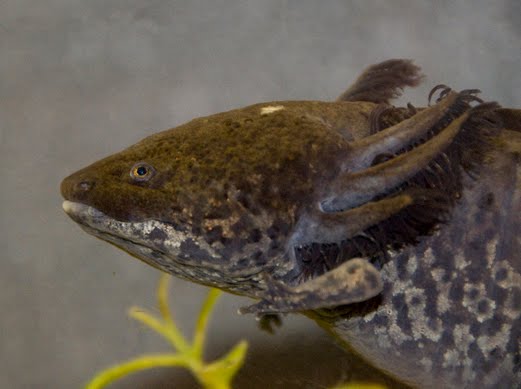
The name of our strange looking salamander, the axolotl, is a mystery to most. The name comes to us through Spanish from Nahuatl, the language spoken by the indigenous Aztec people who first observed these animals.

Say it to rhyme with “max a bottle.”
It can be fun to talk about and learn the words scientists use to describe the world around them. At times, it is also crucial in order to communicate. Learning vocabulary and using it correctly makes it possible to communicate despite the barriers of language, distance and time.
But don't let scientific terms scare you or create a barrier to learning. If you see something new, exciting or fascinating, don’t worry that you can’t describe it technically – say what you saw. Ultimately science is about observation. If you love to observe, you can become motivated to learn the vocabulary.
Read more!
Tuesday, March 9, 2010
Tide Pool Census 2009

Pacific Science Center’s Puget Sound Saltwater Tide Pool is home to animals collected under a Scientific Collection permit, issued by the Washington State Department of Fish and Wildlife (WSDFW). Without a permit, it is illegal to gather animals from beaches. With a permit, it is still Pacific Science Center’s responsibility to take animals correctly, gathering only what will be used and leaving the environment as intact as possible.
Each year we submit a list of all the animals we have collected in the last 12 months. In addition to being a requirement, this is a tool for us to assess how well different species do in the exhibit.
Below is a list of the animals collected in 2009 and the census of animals present at year’s end. This is a shorter version of the list we give the WSDFW, which gives details to genus or species level.

In some cases, there are more animals listed than we collected in 2009. The extras are animals collected in previous years – a sign that they are doing well in husbandry for that group.
Other animals are collected in substantial numbers and yet none are present at year’s end. In the case of shellfish, this is planned. Clams, barnacles and mussels are collected as food items for the sea stars. In other cases, such as “small assorted animals” we may still have the animals but cannot find them. Isopods, tiny anemones and small shrimp routinely work their way into our filter beds, where they live free from predators, and well nourished by the remnants of food left by other animals.
In some cases, though, the species is simply not doing well in our environment. Sand dollars, for example, have very specific habitat needs that are not met in our enclosure. This is an animal we are unlikely to collect in the future.
We had a very marked change in survival rates for anemones, urchins, and sea stars when we installed a hand rinse sink in 2003. Previously these animals could not be touched without rapid loss of health. Now they are highly resilient to touching. Contaminants on people’s hands were more harmful than the physical fact of being touched.
Hermit crabs are a special case because guests are allowed to handle them. Sadly, they did not experience the same jump in survival rates when we got the sink, and we are still working on ways to increase their longevity. The biggest risks to our hermit crabs seem to be, in order from highest to lowest: wandering into unsafe areas, fighting with each other, and rough handling by people. One way we have found to keep them healthy is to keep the population relatively low. An enclosure with twelve to 15 hermit crabs will remain stable, but one with twenty or more will experience losses until the number drops below 15.
Keeping these statistics is the best way for Animal Caretakers to track and assess our tidepool husbandry procedures.
-Sarah Moore, Life Sciences Manager
Monday, November 23, 2009
Tide Pool Etiquette, Part 2

For many of our visitors, one of the most memorable experiences they can have at Pacific Science Center is at our Puget Sound Saltwater Tide Pool. But it’s not just about playing in water and touching weird things. Our goal in having a Tide Pool is to provide visitors with an opportunity to see and touch some of the many organisms that make Puget Sound unique and to learn how to interact with them in the wild. So whether you’re visiting our touch tank or headed out to the beach, we ask that you keep the following protocol in mind.
One sea animal that is common both in Puget Sound and in our Tide Pool is the sea anemone. A kid might say it resembles a toothbrush with a suction cup at the bottom. Sea anemones are also often mistaken for plants. In reality, they are animals. Although it is tempting to try to peel them off of rocks, this can hurt them. It is best to leave an anemone where it is. If you are curious, touch the anemone with two gentle fingers. Watch out for little ones because they may use something else, like their tongues!
Sea stars look rough and sturdy but they are fragile like most other tide pool animals! Like sea anemones, sea stars also stick to rocks, clams, and the sea floor. Do you think it would be a good idea to pull a sea star away from a rock? Of course not! This tears off the tiny tube feet that they use to hold onto things and to move around. You can touch a sea star with two fingers and feel its rough endoskeleton, but please never pull one off of any surface!
In our tide pool, we have a Plexiglas box of hermit crabs that visitors can hold. In the wild, it may be more difficult to find hermit crabs. They usually hide out under big rocks. No matter where you find them, treat them with care! Don’t forget - they can pinch you. At the seashore, stay close to the ground when you hold a hermit crab, in case you drop it. In our tide pool we tell our visitors that if they want to pick up a hermit crab, they must keep their hands over or in the water. We also tell our visitors to put the hermit crabs back in their box so they won’t get eaten by anemones or sea stars. In the wild there isn’t a box to protect hermit crabs but still, you should put a hermit crab back where you found it. Please don’t take it away from its home.
Finally, there are some animals you just shouldn’t touch whether you are visiting our tide pool or visiting a beach, including all species of fish. In Pacific Science Center’s tide pool, we have a very special fish: “Grunty,” the Grunt sculpin, our tide pool mascot. He is very cute and tempting to touch because he tends to swim in the shallow areas within easy reach of visitors. Grunty, like all fish, has a special mucus membrane over his scales that protects him from disease. If you touch a fish, you might take off that protective coating. Remember, without touching fish you can still learn a great deal about them. Observe how they use their fins to swim or compare how a small fish swims as opposed to a bigger fish.If you keep in mind these few guidelines, you and all of the animals you find should have a great time the next time you visit the seashore or Pacific Science Center!
This is the follow up to Nancy’s November 10, 2009 article on Tide Pool Etiquette . Our guest author/ photographer is a Volunteer and a Discovery Corps Internship Graduate.
Read more!