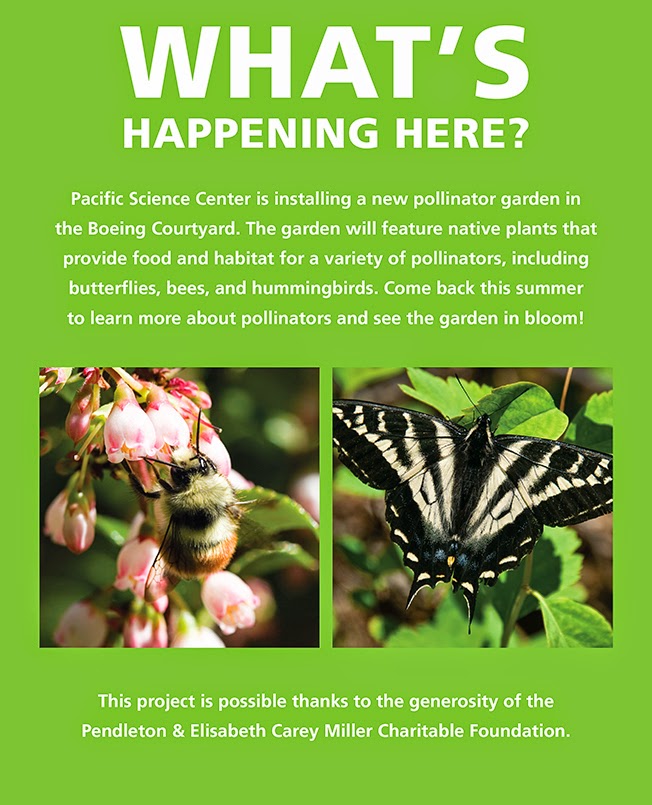
If you've visited Pacific Science Center in the last several months, you may have noticed some gardening activity along the Boeing IMAX walkway. What's going on here?
Thanks to a generous grant from the Pendleton and Elisabeth Miller Charitable Foundation, Pacific Science Center will soon have a Pollinator Garden. Half of the garden was planted in March, and the second half will be planted in June.
You may be wondering, what is a pollinator? Pollinators are animals that help plants reproduce. Because plants are relatively immobile, many rely on animals for reproduction. Plants attract animals to visit their flowers using colors, scents, and rewards like nectar. By visiting multiple flowers, animals transfer pollen between plants, which allow the plants to produce seeds and fruits. Pollination is tremendously important for ecosystems and for human food-production. Some studies estimate that one-third of the food that humans eat is dependent on pollinators visiting flowers. Do you enjoy eating strawberries, apples, or chocolate? Thank a pollinator.
Unfortunately, many pollinators are having a tough time. Habitat loss, ecosystem disruptions, disease, and pesticides all play a role in pollinator decline. Their decline impacts human food supply, as well as the health and diversity of ecosystems.
The Pollinator Garden at Pacific Science Center will be a place for visitors to see local pollinators and learn more about how to help them. The garden will feature Northwest native plants, as native plants are the most likely to attract and support native pollinator species. A variety of flowering plants with different bloom times were chose to provide many months of nectar and pollen for adult pollinators. Several wind-pollinated plants were added to provide food and habitat for butterfly caterpillars and nesting pollinators. Some of the pollinators we hope to attract to the garden include native butterflies, hummingbirds, bees, bee flies, and beetles.
Come stroll through the Pollinator Garden at Pacific Science Center this summer to enjoy the flowers and spot some pollinators!
Species Name(Common Name)
Adiantum aleuticum (Western maidenhair fern)
Aquilegia formosa (Western columbine)
Arctostaphylos uva-ursi (Kinnikinnick)
Asarum caudatum (Western wild ginger)
Athyrium filix-femina (Lady fern)
Betula papyrifera (Paper birch)
Camassia leichtlinii ssp. Suksdorfii (Greater camas)
Ceanothus velutinus (Snowbrush ceanothus)
Cornus canadensis (Canadian bunchberry)
Cornus sericea (Red-twig dogwood)
Dicentra formosa (Pacific bleeding heart)
Dodecatheon hendersonii (Henderson's shooting star)
Epipactis gigantea (Chatterbox orchid)
Erythronium oregonum (Giant white fawn lily)
Erythronium revolutum (Mahogany fawn lily)
Festuca roemeri (Roemer’s fescue)
Festuca rubra (Red fescue)
Fragaria virginia (Virginia strawberry)
Fritillaria camschatcensis (Kamchatka fritillary)
Gaultheria shallon (Salal)
Lilium columbianum (Columbia lily)
Lonicera ciliosa (Western trumpet honeysuckle)
Mahonia nervosa (Low Oregon grape)
Penstemon davidsonii (Davidson's penstemon)
Penstemon rupicola (Rock penstemon / Cliff beardtongue)
Philadelphus lewisii (Lewis’s mock orange)
Physocarpus capitatus (Pacific ninebark)
Pleuropogon refractus (Nodding semaphore grass)
Quercus vaccinifolia (Huckleberry oak)
Rhododendron occidentale (Western azalea)
Rhus glabra cismontana (Dwarf smooth sumac)
Ribes aureum var. areum (Golden current)
Ribes sanguineum (Red flowering current)
Spiraea douglasii (Douglas' spiraea)
Spiraea splendens var. splendens (Rose meadowsweet)
Symphoricarpos albus var. laevigatus (Snowberry)
Trillium ovatum (Western trillium)
Vaccinium ovatum (Evergreen huckleberry)
Vancouveria hexandra (White inside-out flower)
Read more!
Showing posts with label birds. Show all posts
Monday, May 12, 2014
Tuesday, May 3, 2011
Please Don’t Touch The Babies!

In addition to our many fascinating exhibit animals, Pacific Science Center is also home to many wildlife species. While most of these animals are rarely seen, the birds become very conspicuous in spring, as hatchlings outgrow their nests and begin the difficult process of learning to fly. The recent influx of wildlife on our grounds this spring had us thinking about some tips that can help humans to interact with these animals in a way that’s safe for both people and the creatures that share our city habitat.

At different times, staff have reported seeing or hearing evidence of tree frogs, newts, several types of native butterflies, bumble bees, dragon flies, raccoons, opossums, squirrels, bats and a wide variety of birds ranging in size from the occasional Canada goose or bald eagle down to hummingbirds.
In general, Animal Care does not feed, tend or interact with the wildlife. But in one very strange exception: A sea star was found outside Pacific Science Center’s main gates. At first we thought it had been taken from our touch tank, but a staff member reported that a gull had dropped it there. It was still alive and joined our Tide Pool exhibit.

Spring is baby bird season, and in the coming weeks we will start to see fledgling birds of many kinds, often looking cute but bedraggled as they develop from hatchlings to fully feathered young. Our landscape, with seeds and flowers in many seasons and trees of various heights, invites nest building and safely harbors young birds. After a few weeks in the nest, baby birds are large enough to stretch their flight muscles, but still not fully capable of flight. They flutter down from their nests and take up residence on the ground.
At this time, well-meaning people pick up the babies and either put them back in the nest, or bring them to animal care facilities. Please do not do this unless you are certain an animal is in danger. A young animal’s parents will give it better care and protection than any human is able to.

Most baby birds look nearly as large as their parents. They need long wings and big feathers to fly, and their bodies are racing to reach that size. Young gulls are a good example of this. They are grey rather than white, perhaps so their parents can spot them better. A grey gull that cannot fly but is otherwise alert and healthy looking has probably left the nest but is still being tended by its parents.
In addition to harming the animal, moving baby birds is potentially risky to the person doing it. The parents may be nearby and will often fiercely defend their young. Even small birds have sharp claws and beaks, and a cut or scrape from them is not clean, and liable to infection. Birds can also carry a variety of germs and parasites, some of which can be passed on to people.

Young wildlife faces many challenges, from temperature extremes to predators to disease and parasites. But their parents are uniquely adapted to care for them, and if there is ever a choice, they should be left to the best caretakers possible. Here’s wishing all our human and animal friends a happy Mother’s Day!
The photograph of the juvenile gulls is in the public domain.
Read more!
Labels:
baby animals,
birds
Subscribe to:
Posts (Atom)


