We are sad to announce that last week during a routine morning check we found our red-tailed boa constrictor, Estrella, dead in her cage. Her death came as a shock to us all. Up until the end, she showed no signs of slowing down. In fact as recently as Aug 8th, she performed in a show at a Mercer Slough summer camp, doing what she did best – putting on a great show.
Estrella and her clutch mates Esteban and Estella came to Pacific Science Center in 2000 as young snakes. As they grew, each manifested a unique personality that belied the notion that all snakes are essentially interchangeable.
Estrella had always been the pistol, the spark, and the hotshot of our boa constrictor collection. She was the one who always struck at her food. For many years she was deeply and somewhat fearfully respected by generations of the presentation staff. They loved Estrella’s confidence and vigor but were kept on the alert by her moving about, showing her moods, and displaying a big, powerful personality.
When Estrella ate, she would seize the rat out of the tongs, crush it as though it were not dead, and wolf it down with gusto. It was fascinating to watch an animal go from motionless to lightning-quick so rapidly. Estrella clearly showed what extraordinary hunters these snakes can be. Occasionally we would offer Estrella more than one food item. Unlike our other boa constrictors, she would always strike at each one.
But Estrella also had a cranky side. She was known to hiss, show her fangs, and put her handlers on alert when she didn’t like something. On the rare occasions when we took her to the vet for suspected health problems, it was always because of her showing these threatening behaviors. These actions were her way of communicating to us when she felt something was not right.
Estrella always mellowed a bit once we got her feeling better. Then she would put on a fantastic performance and win everyone over with her strength, confidence, and willingness to wrap around the handler’s waist and stay in place for the entire length of a show.
Estrella had a few short illnesses in her fourteen years and Animal Care staff did not see the old crankiness that preceded her death.
We will miss her.
Read more!
Showing posts with label Boa constrictors. Show all posts
Wednesday, August 20, 2014
Wednesday, March 26, 2014
Our Snake with an Ache
So much of a snake’s anatomy is vertebrae. The very phrase “a snake with a back ache” sounds like a definition of misery. So when our red boa constrictor, Esteban, started showing signs of stiffness and discomfort in two sections of his spine, we knew at once we wanted to help him feel better.
During his quarterly house call, Dr. Maas observed each of our snakes as they moved about on the ground. We rarely get a chance to see the natural movement of our boas because they’re either in their cages or in the hands of presenters. This was a good opportunity for Animal Caretakers to watch our large snakes in action.
A snake with complete range of motion, like Estrella, forms rounded shapes, like the letter “S”. She can move easily through all her vertebrae. When her tail is gently squeezed, she immediately pulls it out of our grip. This is consistent with what our presentation staff tell us about her; Estrella tightly wraps herself around the waist of the person handling her.
Compared to Estrella, Esteban shows a much more limited range of comfortable positions. There are two areas that he always seems reluctant to bend. Esteban has a pain in the neck and a pain in the tail. His tail is also weakened. When gently squeezed, he had almost no reaction at all. When placed on the floor, he could not flex his tail to move. Instead, he had to ‘caterpillar’ the lower part of his body, contracting his muscles to scoot along rather than undulating.
Esteban is showing signs of arthritis! There is some good news for the short term. We will begin giving him anti-inflammatory medication that will reduce the tissue swelling around the arthritic area, and give him back much of his comfort and ability to move. He should stop losing strength and perhaps make some gains.
Unfortunately, this is a progressive condition that can’t reverse itself and that will eventually get worse over time. With good care, we hope that Esteban will be happy and comfortable for years to come.
Read more!
During his quarterly house call, Dr. Maas observed each of our snakes as they moved about on the ground. We rarely get a chance to see the natural movement of our boas because they’re either in their cages or in the hands of presenters. This was a good opportunity for Animal Caretakers to watch our large snakes in action.
A snake with complete range of motion, like Estrella, forms rounded shapes, like the letter “S”. She can move easily through all her vertebrae. When her tail is gently squeezed, she immediately pulls it out of our grip. This is consistent with what our presentation staff tell us about her; Estrella tightly wraps herself around the waist of the person handling her.
Compared to Estrella, Esteban shows a much more limited range of comfortable positions. There are two areas that he always seems reluctant to bend. Esteban has a pain in the neck and a pain in the tail. His tail is also weakened. When gently squeezed, he had almost no reaction at all. When placed on the floor, he could not flex his tail to move. Instead, he had to ‘caterpillar’ the lower part of his body, contracting his muscles to scoot along rather than undulating.
Esteban is showing signs of arthritis! There is some good news for the short term. We will begin giving him anti-inflammatory medication that will reduce the tissue swelling around the arthritic area, and give him back much of his comfort and ability to move. He should stop losing strength and perhaps make some gains.
Unfortunately, this is a progressive condition that can’t reverse itself and that will eventually get worse over time. With good care, we hope that Esteban will be happy and comfortable for years to come.
Read more!
Labels:
Boa constrictors,
Snakes
Wednesday, January 11, 2012
Snake Eyes

Over the last few months, Animal Care staff noticed something a little funny about one of our boa constrictors. Esteban’s eye appeared cloudy, as though a thin white film were covering part of his eye and pupil. While snakes normally experience a brief period before shedding when their eyes cloud over and are nearly opaque, the rest of the time they are usually bright, shiny and clear.
When we brought him to The Center for Bird and Exotic Animal Medicine (BEAM), Dr. Maas used a bright, narrow beam light to pinpoint the source of the clouding. To our relief, it was not deep in the eye like a cataract, but right on the surface of the eye.

To understand what we did next, it is necessary to understand a bit of snake eye anatomy. Snakes are well known for their unblinking stare, and in fact snakes are unable to blink. Their eyelids are greatly modified, into a fused, clear covering over the eye, called a spectacle or eye cap.
This cap is strong enough that snakes can strike their prey, swim, slide through underbrush, and in some species use their heads for digging, all without blinking and without damage to their eyes. The spectacle itself may be scuffed up in the course of daily activities, but luckily it is shed when the snake sheds its skin, so it is always being replaced by a newer, clear covering.

Snakes’ eyes are mobile, and to allow this, there is a layer of liquid, like our tears, between the eye itself and the spectacle. Our concern was that if the eye were infected, bacteria would grow in that liquid layer, and be the source of the clouding.
To see what was going on with Esteban’s eye, Dr. Maas carefully inserted a very small needle between the spectacle and the eye, and removed a small amount of this liquid for testing. What he found was reassuring.

Esteban has no sign of infection in his eye tissue. Most likely, he produced excess protein due to a minor injury, or slight inflammation, and the cloudiness will take care of itself in the next few sheds. If not, we will need to inject minute amounts of anti-inflammatories into the space around Esteban’s eye – not a task for the faint of heart.
Read more!
Labels:
Boa constrictors,
Snakes
Sunday, May 22, 2011
Snake Weight, Don’t Tell Me!

In anticipation of the recent vet visit from Dr. Maas of The Center for Bird and Exotic Animal Medicine, Animal Care staff performed the quarterly weigh-in of our reptiles.

We weigh the boa constrictors by weighing staff members with and without snakes, and subtracting the difference. This is simple arithmetic, which we sometimes ask younger guests to help with. Any chance to sneak math into the day is worth it.

Here are the results:
Estrella – (21.6 lbs.) 9.8 kg, (7ft 10in) 2.4 meters
Esteban – (19.4 lbs.) 8.7 kg, (8ft) 2.4 meters
Estella – (24.8 lbs.) 11.2 kg, (7ft 11in) 2.4 meters
Why do we convert pounds and feet to metric readings? Partially, we do this because metric measurements are accepted universally. Even more importantly, we like to know the animals’ weights in kilograms because nearly all medication is dispensed in units per gram or kilogram, and the math is much simpler if we already have the weights in those increments.

Measuring a snake’s length is tricky. Snakes rarely stretch out to their full length, and they resist our efforts to make them do so. Instead, we lay string along their spine from head to tail and measure the string. Because the snakes are moving, these measurements are not accurate. However, as we take multiple measurements over time, their averages will come closer to a real reading.

Zea – 460 grams, (45 in) 1.14 meters
Tillamook – 480 grams, (45.5in) 1.15 meters
Nacho – 80 grams, (26.5in) 0.67 meters
Lydia – 100 grams

The corn snakes and the leopard gecko were weighed on a smaller and more precise scale, since a few grams means a lot for an animal of their size. If Estella gained or lost 100 grams (Lydia’s entire weight) it would account for less than 1% of her body weight, so we do not need to weigh her to the same degree of precision.
As we track our animals over time, we hope to see signs of growth in the younger ones, stability in the adults, and help bring Estella, who is a tad heavy and Zea and Tillamook, who are a trifle thin, back to their ideal weights.
Read more!
Labels:
Boa constrictors,
Corn snakes,
reptiles
Monday, January 31, 2011
Urchins AND Snakes!!
This morning, Life Sciences' Sarah Moore and Brianna Todd appeared on KING 5 TV's "New Day Northwest." In addition to green sea urchins, the live television audience got to visit with Esteban, our boa constrictor. Here's the clip!
Read more!
Read more!
Labels:
Boa constrictors,
sea urchins,
Snakes
Sunday, January 16, 2011
Estrella's Strange Behavior

Last week, the daily log was filled with comments on Estrella, the boa constrictor’s unusual behavior. She was described as ‘hissing’ ‘aggressive’, and ‘did not want to move’ when her cage was being cleaned. Although she is always the most active, opinionated and responsive of our snakes, Estrella is normally tractable and fun to work with. So her behavior was alarming.

As always, we need to rule out health problems whenever an animal’s behavior changes. If she has no other way to communicate, a snake who does not feel well may react to handling by biting. For this reason, we treat all behavior issues as possible health problems.
Dr. Maas of Avian and Exotic Animal Hospital in Bothell gave Estrella a head-to-tail exam and commented that if there were no complaint, he would have said she was in excellent health. But to be safe, we did some ultrasound and blood work. The results may explain Estrella’s behavior.

She is starting to ovulate.
Boas are seasonal breeders. A drop in nighttime temperatures triggers the females to begin preparing eggs for fertilization, and the males to get ready to mate. Although we did not intentionally change the temperature of their cages, the cold weather has caused the buildings to be cooler. The snake enclosures have a fairly wide temperature range within them, and the cooler areas probably fell below the point that would induce breeding behavior.
Ovulating can bring about marked changes in snake behavior. They often lose interest in food (though Estrella has not) and may be either withdrawn or cranky. But ovulation is not a medical condition. We were instructed to continue handling Estrella so long as she cooperated, which she has been from the minute she went to the vet. Perhaps Estrella just needed someone to understand her!Read more!
Tuesday, November 16, 2010
How We Feed Our Snakes

If you visit the boa constrictor and corn snake cages at Pacific Science Center, you will notice a blank area on each animal’s sign, where we write in their next feeding time. When the time approaches, we inevitably attract some loyal fans, as well as new guests eager to see what will happen. This article will try to give you a sense of what you might expect to see and learn at a snake feeding.
Warning – This following article contains a graphic descriptions of eating whole rats!
The first thing most people notice is how infrequently the snakes eat. Our boa constrictors eat once a week and our corn snakes eat once every 2 weeks. In fact, they could go much longer between meals and occasionally a perfectly healthy snake will refuse food for several feedings in a row. However, we generally see refusal of food as a warning of other possible problems.There are no known vegetarian snakes; all eat either some kind of animal or eggs or both. We feed our corn snakes mice and our boa constrictors mice or rats. All of our snakes are constrictors, which means they use their bodies to wrap around prey animals and suffocate them.

In captivity, it is wise to feed snakes a prey that has already been killed. Live prey can fight back and injure the snake, sometimes quite badly. Or if the snake is not hungry, the caretaker can be injured while taking out an uneaten –and angry – prey animal.
Note: We do not kill the rats and mice that we offer our snakes. They are shipped to us frozen, after being humanely euthanized.

A snake that has been fed killed prey her entire life may still strike at her food, as it is instinctive for them. This is scary. The snake slams into the food with her mouth open, seizing it and holding it while she constricts. It can take up to several minutes before she relaxes her hold. If our Animal Care staff seems jittery during feeding, it may be because it is very hard not to have a reflexive reaction when this happens.

Because of their unique anatomy, snakes swallow their prey whole. They usually start at the nose of their prey, which allows for a more streamlined swallowing of limbs than starting at the other end. Snake jaws have a unique ability to separate to allow them to open wide enough. They can continue to breathe while swallowing thanks to the placement of the epiglottis on the lower part of the mouth. The snake’s teeth are too pointed and delicate for chewing, but their backward curve helps them to push the food backward. Snakes surround their food with a thick mucous as they swallow. This helps protect their throats from being abraded by they hair and claws of their victim.

Once the snake finishes eating, we give them at least three days off to digest. They are not scheduled for demonstrations and we handle them only when they need cleaning or medical attention. Swallowing food whole is hard work and they need plenty of time to rest afterwards.

If you’d like to see a snake feeding live and in person, come visit us at Pacific Science Center. Snake feedings are generally scheduled for Saturday, Sunday, and Wednesday afternoons. But please remember these are live animals and we can’t always guarantee that they will eat as scheduled.
Read more!
Labels:
Boa constrictors,
Corn snakes,
Snakes
Tuesday, October 5, 2010
Helping the medicine go down

When staff at Pacific Science Center prepare to work with reptiles, we are trained on preventing the spread of the Salmonella bacteria, and instructed to view our reptiles as potential salmonella carriers. Many of our handling, care, and public contact rules come from this training.
So getting a positive salmonella test result back from Avian and Exotic Animal Hospital when they tested our boa constrictors was not entirely unexpected.

However, in the case of one snake, Estrella, an elevated population of these bacteria in her gut may have led to other behavior problems and an overall decline in health. Dr. Maas suggested an aggressive course of antibiotic treatment for all three boa constrictors, to either eliminate the bacteria, or at least reduce the levels to a point where more beneficial gut bacteria could hold them in check. This would get Estrella back into the pink and keep Esteban and Estella feeling great.

Each snake is given approximately 0.5 cc of medicine, orally, each morning for 30 days. Medicating a snake is easier said than done.
If you have medicated a dog or cat, you know to aim for the back of the mouth, so that the animal tastes less and swallows more quickly. This is even more important with snakes. First, snakes’ mouths are good at swallowing large prey items, but they are not good at retaining liquid. Medication placed near the front of the mouth has a habit of leaking back out.

More frightening, a snake’s epiglottis (opening to their windpipe) is located on the bottom of the mouth, and can be moved quite far forward. This allows snakes to breathe while to swallowing prey. Unfortunately, it means we risk accidentally administering medication into a snake’s lung instead of its stomach. We use a tube to make sure the liquid gets down to the back of the mouth. Watch out for teeth!

Contrary to myth, snakes are not actually slimy. They are very smooth, nonetheless, and slide through our grip when we try to restrain them. A firm hand, and a quick partner giving the medication, gets the job done.

Estrella is already feeling much better and doesn’t seem to hold a grudge against us for giving her medication. Esteban and Estella are doing great as well.
Read more!
Wednesday, September 8, 2010
More Snake Science

Have you ever read an account of a thirty, forty or more foot snake, and wondered if that could be true?
If the measurement came from the shed skin of the snake, it should be viewed with skepticism.

A couple of weeks ago, Estrella the boa constrictor shed her skin. To our delight, the shed was very complete with no scales scraped off and few broken pieces. We like to find sheds like this because it is one of the signs that a snake is healthy. Snakes with illnesses or injuries will often shed in patches, leaving loose scales throughout their cage.
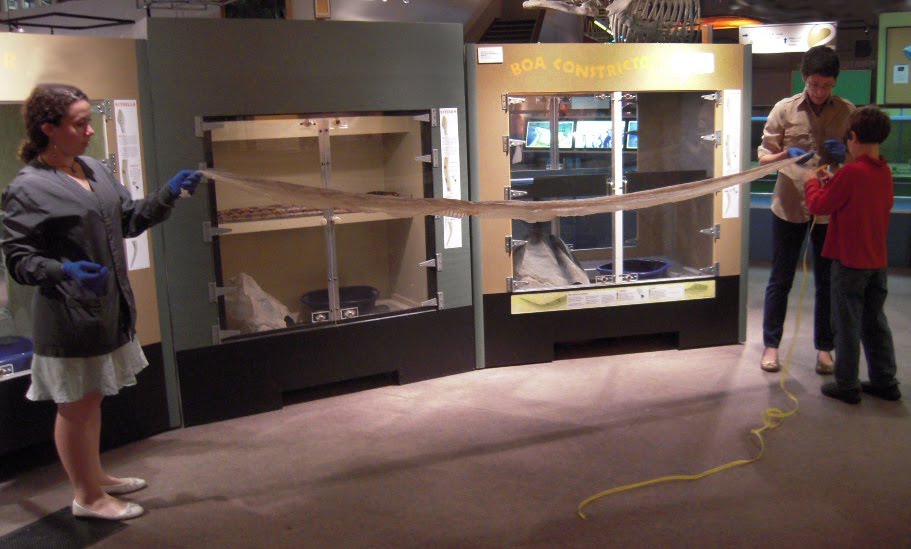
Estrella’s skin was so perfect that we decided to do an experiment. We measured the skin, holding it straight but loosely so as not to stretch it. We also measured Estrella herself. Snakes are not cooperative about being measured. Even with two people holding her and two measuring, she did not stretch out completely straight. We compensated for this by adding 1 foot to her measurement - the estimated length of her curved section.

The results: Estrella’s length = 7’ 6” (213 cm). Estrella’s shed skin’s length = 10’ 8” (305 cm). That’s right. Estrella’s shed skin is 143% of her actual length.

Why is this? When a snake is “wearing” her skin, the scales overlap with thin connective tissue holding each thicker scale together. When she sheds, the scales lie flat, the connective tissue stretches out, and voila! The skin is longer than the animal who wore it.
Read more!
Labels:
Boa constrictors,
Snakes
Tuesday, August 31, 2010
Snakes on a … diet

Two of Pacific Science Center's boa constrictors, Esteban and Estella, just got some pleasant news from the scale. Esteban weighed in at 20.6 pounds (9.36 kilos), down from an all time high weight of 22 pounds in 2007. Estella has lost weight too – down to 24.8 pounds (11.27 kilos), from her highest weight of 26 pounds.

While our animal care staff normally looks at weight loss in our animals as alarming, in this case it was great news. Esteban’s weight is fairly good but slightly heavy, while Estella is decidedly overweight. We could not see her spine at all, and when she stayed still, her skin formed folds from the excess fat. Not only could her health be impacted, but also a heavy snake is harder to handle, leading to a cycle where she gets less handling, less exercise and less chance to lose weight.

Surprisingly, we were given the same advice that helps some people. Feed her smaller, more frequent meals. “Frequent” is relative here. She went from eating one rat every two weeks, to eating a smaller one weekly. We asked our presentation staff to make a point of getting her out for presentations. Being handled and held is a great form of healthy activity. Her weight seems to be nudging down, while her overall health is excellent.

How do we weigh the snakes? We weigh ourselves with and without a snake and subtract the difference. We use the giant scale in building 2, because it is there.

Luckily neither of the snakes is on the sun!
Read more!
Labels:
Boa constrictors,
Snakes
Tuesday, February 2, 2010
January Vet Visit

On Jan 19, Dr. Maas and Dr. Temple from Avian and Exotic Animal Hospital paid a routine house call to Pacific Science Center’s animals.

Each of our snakes received a full physical exam from head to tail. The insides of their mouths were examined for broken teeth, pale gums, excess saliva, or loud breathing. The skin was inspected as well. Snake skin should be clear and unblemished, without old scales from previous skin sheds.

Snake’s undersides were felt for lumps or irregularities. Overall conditions were noted. Estella is a little heavy! Dr. Maas recommended we feed each of the boa constrictors a small rat on a weekly schedule.

It was in this exam that a strange lump was felt in Maizey, the corn snake’s abdomen. As previously explained, Dr. Maas took Maizey back to his hospital for further examination with sad results.

Lydia, the leopard gecko, looks great. She has a fat tail which is a sign of good health in these animals. We were warned to not associate her with other leopard geckos as they might not be as healthy.

Dr. Maas recommended that we house our African dwarf frogs separate from the axolotls. Their skin is toxic to axolotls. The frogs are currently partitioned from the axolotls with a simple tank divider. Should a frog escape and end up in an axolotl mouth, it could be fatal to both animals. Stay tuned! Plans for a separate dwarf frog exhibit are in the works!

The naked mole-rats were looked at for overall colony health. Most of them have gained weight over the last year. Pups from our two recent litters are nearly the size of the smallest adults. Unfortunately, a few individuals are not thriving. We discussed how best to monitor them, and set up a plan for a thorough colony clean. In future articles, we’ll discuss our naked mole-rat husbandry routines and report on the results.

All in all, the vets’ visit was careful, thorough, and exhaustive. Animal Care staff always learns a lot from these house calls which help us better care for our animals.
Thanks to Alice Enevoldsen, Pacific Science Center’s planetarium specialist, for photographing the veterinarians’ visit.
Read more!
Subscribe to:
Comments (Atom)