When Animal Care recently received a shipment of stick insects identified as Baculum extradentatum, (Giant Vietnamese stick insects), we naturally assumed that would be what we were getting. We were planning on adding this shipment of walking sticks to our current population to add in some genetic diversity and hopefully a few males to our all-female parthenogenic group.
As soon as we unpacked this new group of phasmids, it was clear that they were not the same as our current population. Perhaps we were looking at males instead of all the females we are accustomed to. But soon we realized that there were more differences. We were looking at a new species.
When we receive a new species of stick insect, we don’t simply slap a new sign onto a cage. These animals have the potential to become as invasive as the Indian stick insects in California. We first needed to figure out what species these insects were and then make sure we had a permit for them – fast! Otherwise, we wouldn’t be able to keep the new shipment.
Thanks to the powers of the Internet, Lead Animal Caretaker Lauren Bloomenthal contacted phasmid authority, Paul Brock, of London’s Natural History Museum. With full body photographs and a couple of shots of the insect’s head and genitalia, the expert soon replied with a name: Lonchodiodes samarensis. Their common name is Colorful Samar walking stick and "colorful" they are!
Unfortunately, even though we had a name, this species still wasn’t on our permits, so their fate was still up in the air. Life Sciences Manager Sarah Moore contacted our officer with the United States Department of Agriculture and explained our situation, fearing that nothing could be done to keep these animals. But he wrote back to say that the USDA would add the phasmids to our permit. We could keep and display these beautiful stick insects! Perhaps our excellent record of care worked in our favor to make this possible.
Lonchodiodes samarensis are now on display in the Insect Village. They are originally native to the Northern Province of the Island of Samar in the Philippines. Very little information is known about this species but we look forward to learning more about them as we see them grow and thrive in their new home.
Read more!
Wednesday, August 12, 2015
Saturday, August 8, 2015
Fresh Sheet – August 8, 2015
Soon our Tropical Butterfly House will be flying two different species from the genus Anartia: Anartia fatima (Banded Peacock) which only live north of the Darien Peninsula of Panama through Central America and the Southern United States and Anartia amanthea (Scarlet Peacock), which only live south of the Darien Peninsula of Panama through South America and the West Indies. Except for a narrow band along the coast where these two species interbreed and hybridize, the two species do not migrate any further north or south. However, scientists have noticed that this zone of hybridization is shifting northward.
Suministros Entimológicos Costarricenses, SA
Costa Rica
21 - Anartia fatima (Banded Peacock)
04 - Appias drusilla (Tropical White)
05 - Brassolis isthmia (Small-spotted Owl)
05 - Caligo atreus (Yellow-Edged Giant-Owl)
24 - Caligo memnon (Owl Butterfly)
20 - Catonephele numilia (Numilia)
10 - Eryphanis polyxena (Purple Mort Bleu Owl)
07 - Eueiudes isabella (Isabella’s Longwing)
20 - Greta oto (Glasswing)
33 - Hamadryas amphinome (Red Calico)
04 - Hamadryas februa (Gray Calico)
14 - Hamadryas feronia (Variable Calico)
07 - Hamadryas laodamia (Starry Calico)
12 - Heliconius erato (Small Postman)
18 - Heliconius hecale (Tiger Longwing)
08 - Heliconius hewitsoni (Hewitson’s Longwing)
08 - Heliconius ismenius (Ismenius Longwing)
37 - Heliconius melpomene (Postman)
15 - Heliconius sapho (Sapho Longwing)
12 - Heraclides anchisiades (Ruby-spotted Swallowtail)
31 - Morpho peleides (Blue Morpho)
39 - Myscelia cyaniris (Blue Wave Butterfly)
11 - Nessaea aglaura (Aglaura Olivewing)
09 - Papilio thoas (Thoas Swallowtail)
07 - Parides iphidamas (Transandean Cattleheart)
10 - Siproeta epaphus (Rusty-tipped Page)
Total = 391
“Fresh Sheet” is our weekly shipment report of pupae on display in the emerging window. Visit Pacific Science Center’s Tropical Butterfly House and meet our newest residents.
Read more!
Suministros Entimológicos Costarricenses, SA
Costa Rica
21 - Anartia fatima (Banded Peacock)
04 - Appias drusilla (Tropical White)
05 - Brassolis isthmia (Small-spotted Owl)
05 - Caligo atreus (Yellow-Edged Giant-Owl)
24 - Caligo memnon (Owl Butterfly)
20 - Catonephele numilia (Numilia)
10 - Eryphanis polyxena (Purple Mort Bleu Owl)
07 - Eueiudes isabella (Isabella’s Longwing)
20 - Greta oto (Glasswing)
33 - Hamadryas amphinome (Red Calico)
04 - Hamadryas februa (Gray Calico)
14 - Hamadryas feronia (Variable Calico)
07 - Hamadryas laodamia (Starry Calico)
12 - Heliconius erato (Small Postman)
18 - Heliconius hecale (Tiger Longwing)
08 - Heliconius hewitsoni (Hewitson’s Longwing)
08 - Heliconius ismenius (Ismenius Longwing)
37 - Heliconius melpomene (Postman)
15 - Heliconius sapho (Sapho Longwing)
12 - Heraclides anchisiades (Ruby-spotted Swallowtail)
31 - Morpho peleides (Blue Morpho)
39 - Myscelia cyaniris (Blue Wave Butterfly)
11 - Nessaea aglaura (Aglaura Olivewing)
09 - Papilio thoas (Thoas Swallowtail)
07 - Parides iphidamas (Transandean Cattleheart)
10 - Siproeta epaphus (Rusty-tipped Page)
Total = 391
“Fresh Sheet” is our weekly shipment report of pupae on display in the emerging window. Visit Pacific Science Center’s Tropical Butterfly House and meet our newest residents.
Read more!
Thursday, August 6, 2015
How Long Do Butterflies Live?
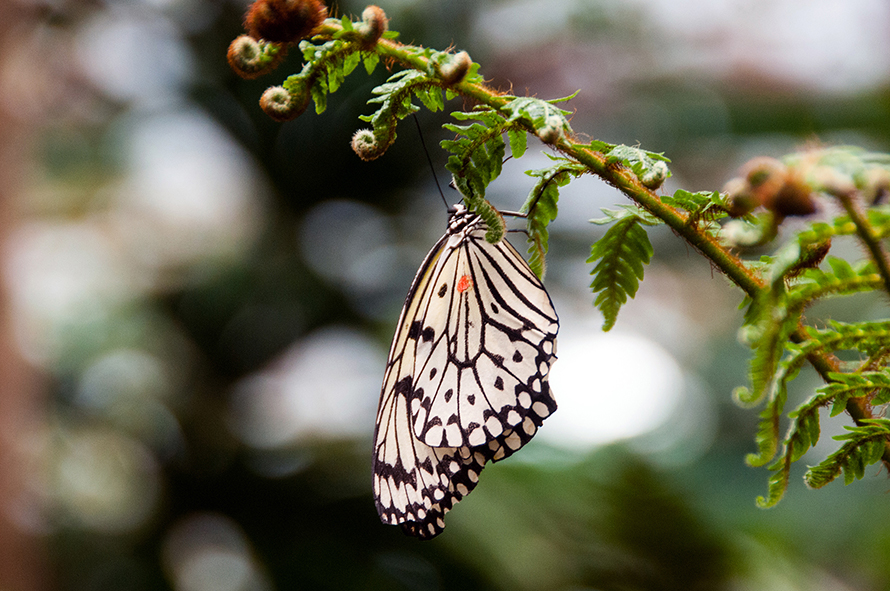
Back in September of last year, our Life Sciences team set off to find out how long do butterflies live. For our first study we chose Idea leuconoe, the paper kite. It was a species of butterfly that we could recognize easily and that would show markings well.
The results were surprising and have led to further studies on additional species.
To track the butterflies, we used paint marker to uniquely identify all the butterflies that emerged each day. The color and number of spots were specific to a date of emergence. When the butterflies died, we collected them, noted the paint marks, and calculated their length of life. For many, many weeks, we continued to have marked butterflies floating about the exhibit. As we watched the butterflies, we began to notice all kinds of interesting behaviors:
• Paper kites roost in large groups at night and during rest periods in the day. They like water and occasionally would have to be rescued from the pond.
• As butterflies go, paper kites are pretty aggressive. They can’t harm other butterflies, but they are quick to pursue them and drive them out of feeding spots.
• They have very strong preferences for certain flowers where they both feed and rest.
As weeks became months, we realized that Idea leuconoe had the potential to live much longer than we originally thought.
Our next step was to study two other species: Morpho peleides, the blue morpho and its relative M. polyphemus, the white morpho. We thought these two butterflies would have a pretty similar life story, but it turned out as we marked and observed them that the blue morpho was seen in more types of environment around the exhibit and was more often seen eating. The white morpho seemed to have very limited places it was found and they were often the species driven off by paper kites!
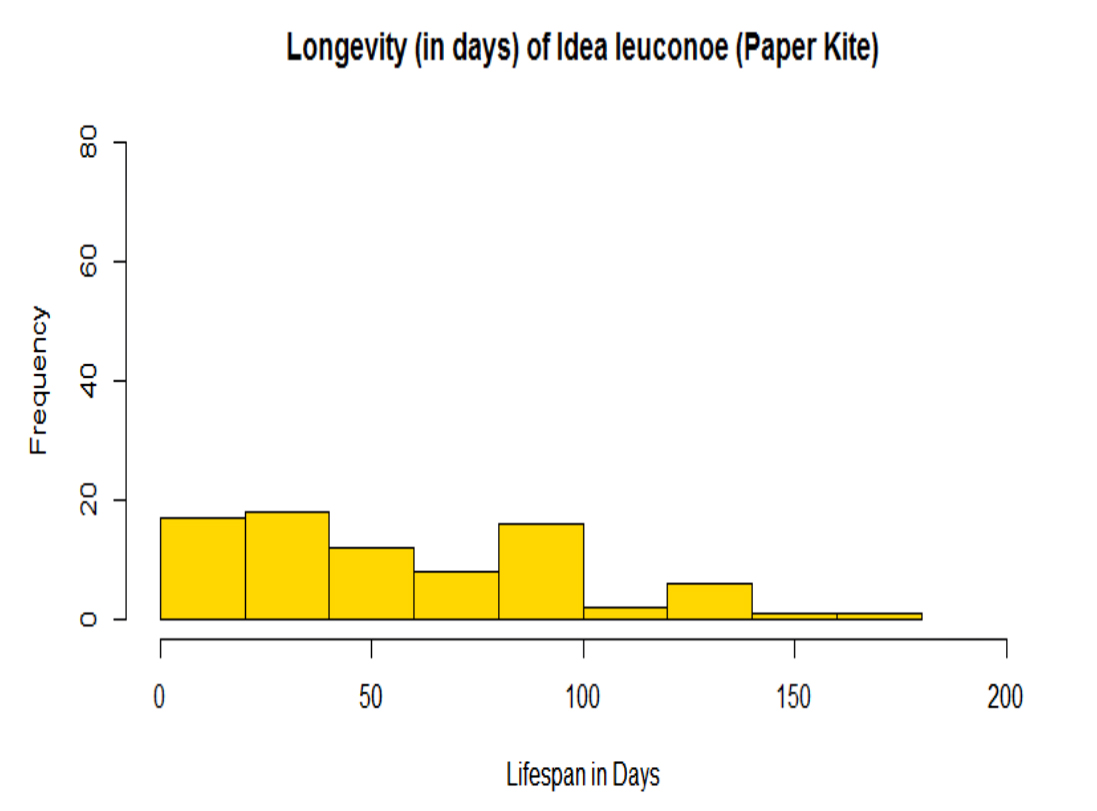
Collecting the butterflies after they died and logging their survival dates was a lesson in patience. With all three species, we had a sizeable group that only lived a handful of days, a bunch that lived an intermediate length, and a few outliers with extremely long lifespans.
With numbers such as this, the median is the best measure of what is really going on. At the median, half the butterflies in the group live longer and half live less long. This protects our numbers from reflecting the very long lives of a few extraordinary individuals.
This study brings up some interesting questions.
• What is going on at the short end of the life spans? Why are some of the butterflies only living a few days? Is this something we can change or are we observing individuals that appear healthy but have hidden issues?
• What is going on at the long end of the life spans? Are some butterflies ‘SuperAgers’ or did they just somehow happen upon all the resources they needed? Is that resource something we can provide for the whole population?
• What should we look at next?
Life Sciences has already begun studying another genus, the Caligo, owl butterflies. Maybe you’ll see some with markings? And then – maybe one of our smaller brightly colored species. Do smaller butterflies have shorter lifespans? Maybe it’s time to find out!
While everyone in Life Sciences worked very hard to mark, collect, photograph, and record the data a special shout-out goes to former Animal Caretaker Whitney Pennington who crunched the numbers, analyzed the records, and created the graphs. Her examination made it possible to answer questions as they came in and gave us confidence that the numbers have real meaning. Thanks, Whitney!
Read more!
The results were surprising and have led to further studies on additional species.
To track the butterflies, we used paint marker to uniquely identify all the butterflies that emerged each day. The color and number of spots were specific to a date of emergence. When the butterflies died, we collected them, noted the paint marks, and calculated their length of life. For many, many weeks, we continued to have marked butterflies floating about the exhibit. As we watched the butterflies, we began to notice all kinds of interesting behaviors:
• Paper kites roost in large groups at night and during rest periods in the day. They like water and occasionally would have to be rescued from the pond.
• As butterflies go, paper kites are pretty aggressive. They can’t harm other butterflies, but they are quick to pursue them and drive them out of feeding spots.
• They have very strong preferences for certain flowers where they both feed and rest.
As weeks became months, we realized that Idea leuconoe had the potential to live much longer than we originally thought.
Our next step was to study two other species: Morpho peleides, the blue morpho and its relative M. polyphemus, the white morpho. We thought these two butterflies would have a pretty similar life story, but it turned out as we marked and observed them that the blue morpho was seen in more types of environment around the exhibit and was more often seen eating. The white morpho seemed to have very limited places it was found and they were often the species driven off by paper kites!
Collecting the butterflies after they died and logging their survival dates was a lesson in patience. With all three species, we had a sizeable group that only lived a handful of days, a bunch that lived an intermediate length, and a few outliers with extremely long lifespans.
With numbers such as this, the median is the best measure of what is really going on. At the median, half the butterflies in the group live longer and half live less long. This protects our numbers from reflecting the very long lives of a few extraordinary individuals.
This study brings up some interesting questions.
• What is going on at the short end of the life spans? Why are some of the butterflies only living a few days? Is this something we can change or are we observing individuals that appear healthy but have hidden issues?
• What is going on at the long end of the life spans? Are some butterflies ‘SuperAgers’ or did they just somehow happen upon all the resources they needed? Is that resource something we can provide for the whole population?
• What should we look at next?
Life Sciences has already begun studying another genus, the Caligo, owl butterflies. Maybe you’ll see some with markings? And then – maybe one of our smaller brightly colored species. Do smaller butterflies have shorter lifespans? Maybe it’s time to find out!
While everyone in Life Sciences worked very hard to mark, collect, photograph, and record the data a special shout-out goes to former Animal Caretaker Whitney Pennington who crunched the numbers, analyzed the records, and created the graphs. Her examination made it possible to answer questions as they came in and gave us confidence that the numbers have real meaning. Thanks, Whitney!
Read more!
Labels:
Idea,
Longevity study,
Morpho peleides,
Morpho polyphemus
Saturday, August 1, 2015
Fresh Sheet – August 1, 2015
Ever wonder why there are a lot of Anartia amathea (Scarlet Peacock) feeding on the Euphorbia milli (Crown of Thorns) in our Tropical Butterfly House? Look closely. This species of butterflies has a short proboscis and the flat-petaled plant accommodates them. Look for these compatible organisms next time you visit.
Neotropical Insects NV
Suriname
24 - Battus polydamas (Polydamus Swallowtail)
40 - Papillio anchisiades (Ruby-spotted Swallowtail)
05 - Heliconius erato (Small Postman)
15 - Heliconius melpomene (Postman)
50 - Dryas iulia (Julia Longwing)
50 - Anartia amathea (Scarlet Peacock)
25 - Caligo memnon (Owl Butterfly)
05 - Eryphanis polyxena (Purple Mort Bleu Owl)
04 - Mechanitis polymnia (Polymnia Tigerwing)
28 - Tithorea harmonia (Harmonia Tigerwing)
Total = 246
Bioproductores de El Salvador
10 - Anaea eurypyle (Pointed Leafwing)
15 - Archeoprepona demophoon (Hubner’s Prepona)
10 - Battus belus (Belus Swallowtail)
20 - Caligo memnon (Owl Butterfly)
25 - Catonephele numilia (Numilia)
15 - Eurytides branchus (Dual-spotted Swallowtail)
15 - Heliconius hecale (Tiger Longwing)
08 - Heliconius hortense (Mountain Longwing)
10 - Heliconius ismenius (Ismenius Longwing)
16 - Morpho polyphemus (White Morpho)
25 - Myscelia ethusa (Royal Blue Butterfly)
20 - Papilio androgeus (Queen Page)
25 - Papilio torquatus (Band-gapped Swallowtail)
06 - Archeoprepona demophon (One-spotted Prepona)
25 - Prepona omphale (Blue Belly-Button)
20 - Tithorea harmonia (Harmonia Tigerwing)
Total = 265
Grand Total = 511
“Fresh Sheet” is our weekly shipment report of pupae on display in the emerging window. Visit Pacific Science Center’s Tropical Butterfly House and meet our newest residents.
Read more!
Neotropical Insects NV
Suriname
24 - Battus polydamas (Polydamus Swallowtail)
40 - Papillio anchisiades (Ruby-spotted Swallowtail)
05 - Heliconius erato (Small Postman)
15 - Heliconius melpomene (Postman)
50 - Dryas iulia (Julia Longwing)
50 - Anartia amathea (Scarlet Peacock)
25 - Caligo memnon (Owl Butterfly)
05 - Eryphanis polyxena (Purple Mort Bleu Owl)
04 - Mechanitis polymnia (Polymnia Tigerwing)
28 - Tithorea harmonia (Harmonia Tigerwing)
Total = 246
Bioproductores de El Salvador
10 - Anaea eurypyle (Pointed Leafwing)
15 - Archeoprepona demophoon (Hubner’s Prepona)
10 - Battus belus (Belus Swallowtail)
20 - Caligo memnon (Owl Butterfly)
25 - Catonephele numilia (Numilia)
15 - Eurytides branchus (Dual-spotted Swallowtail)
15 - Heliconius hecale (Tiger Longwing)
08 - Heliconius hortense (Mountain Longwing)
10 - Heliconius ismenius (Ismenius Longwing)
16 - Morpho polyphemus (White Morpho)
25 - Myscelia ethusa (Royal Blue Butterfly)
20 - Papilio androgeus (Queen Page)
25 - Papilio torquatus (Band-gapped Swallowtail)
06 - Archeoprepona demophon (One-spotted Prepona)
25 - Prepona omphale (Blue Belly-Button)
20 - Tithorea harmonia (Harmonia Tigerwing)
Total = 265
Grand Total = 511
“Fresh Sheet” is our weekly shipment report of pupae on display in the emerging window. Visit Pacific Science Center’s Tropical Butterfly House and meet our newest residents.
Read more!
Subscribe to:
Posts (Atom)